Zero-Trust for Autonomous Agents
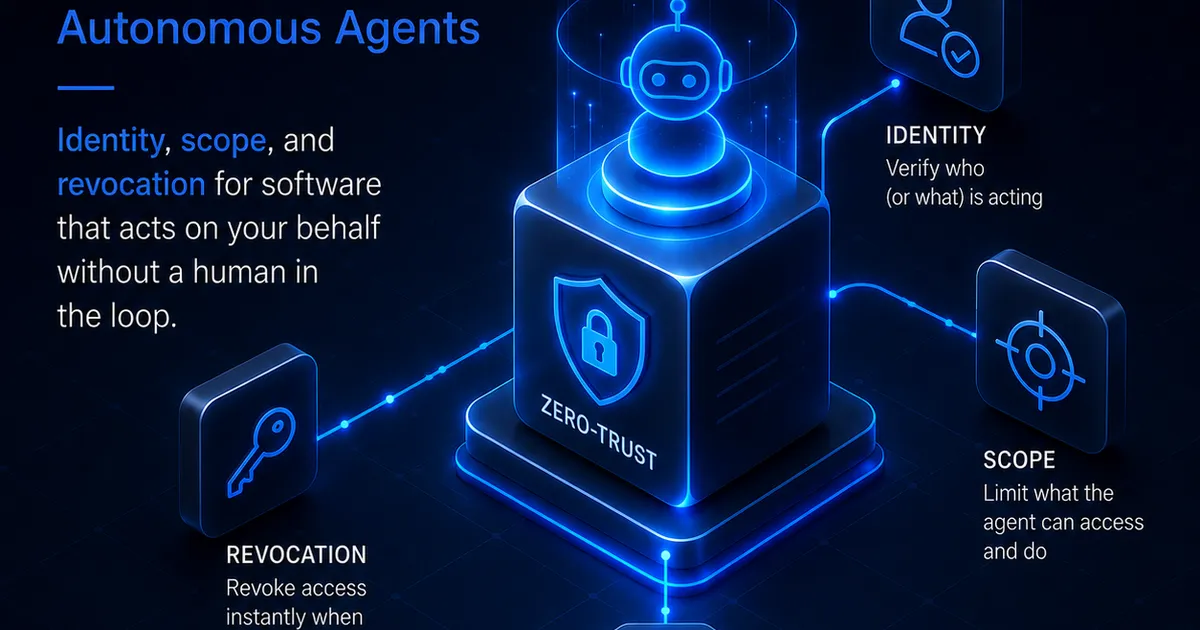
Identity, scope, and revocation for software that acts on your behalf without a human in the loop.
The agent problem
Autonomous agents are software that acts on your behalf. They call APIs, write code, manage infrastructure, and make decisions. The traditional security model — authenticate once, trust indefinitely — doesn’t work here.
An agent is not a user. It’s a user with superpowers and no coffee break.
Identity for agents
Zero-trust starts with identity. For agents, identity means three things:
- Who created the agent — the human or organization responsible
- What the agent is — its model, version, and capabilities
- What the agent is doing — its current task and context
Without this triple identity, you can’t enforce governance. The agent becomes a shadow admin with unlimited access.
Scope and permission
Every agent needs a scope: the exact set of actions it’s authorized to perform. Not “read and write access to the database.” Instead: “read rows from table X where condition Y, write to audit log Z.”
agent_scope:
    identity:
        creator: "jose@fuziontek.co"
        model: "claude-4-opus"
        version: "1.2.0"
    permissions:
        - action: "db.read"
          resource: "analytics.events"
          conditions:
              time_range: "24h"
              rows_limit: 1000
        - action: "api.call"
          resource: "slack.postMessage"
          channel: "#alerts"
    denied:
        - "db.write"
        - "admin.*"
        - "auth.*"
Scope is not a suggestion. It’s enforced at the infrastructure layer. The agent literally cannot perform actions outside its scope.
Revocation
The most important zero-trust capability is revocation. You need to be able to:
- Revoke instantly — kill an agent mid-task without affecting other agents
- Revoke conditionally — if anomalous behavior is detected, auto-revoke
- Revoke gracefully — let the agent finish its current operation, then deny new ones
Revocation is not deletion. The agent’s history, outputs, and audit trail persist. Only its ability to act is removed.
The human loop
Zero-trust for agents doesn’t mean zero trust in humans. It means:
- Humans define scope
- Agents operate within scope
- Systems enforce scope
- Humans review scope violations
The human stays in the loop — not in the execution path, but in the governance layer.
What this means for your architecture
If you’re building autonomous agents today, identity, scope, and revocation are not features. They’re prerequisites. Without them, you’re building a system that trusts everything and verifies nothing.
That’s not autonomy. That’s negligence.