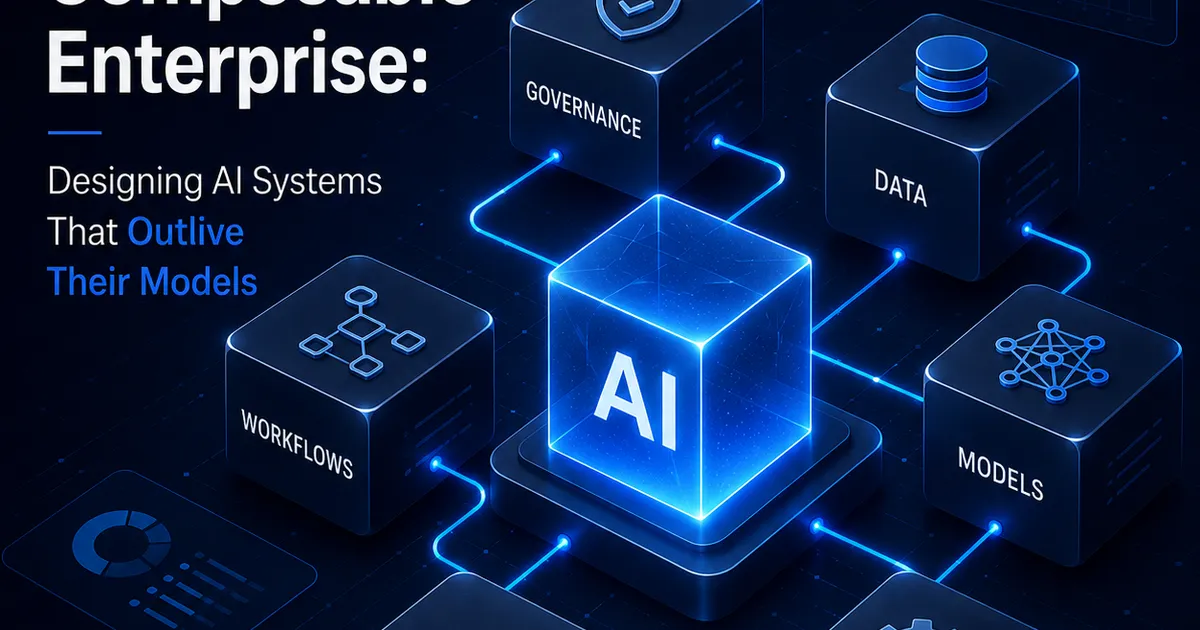
The Composable Enterprise: Designing AI Systems That Outlive Their Models
Model lifecycles are measured in months; enterprise systems in decades. We examine reference architectures that decouple inference from orchestration, so capability can be swapped without rewriting the platform beneath it.
The problem with model-centric architecture
Most enterprise AI systems are built around a single model. The model is the architecture. When the model becomes outdated — and it will, measured in months — the entire system needs to be rewritten.
This is not a technical problem. It’s an architectural one.
Decoupling inference from orchestration
The reference architecture separates the inference layer from the orchestration layer. The inference layer handles model execution: tokenization, batching, GPU scheduling. The orchestration layer handles business logic: routing, aggregation, governance, human-in-the-loop workflows.
┌─────────────────────────────────────────────┐
│              Orchestration Layer             │
│  Routing · Aggregation · Governance · Audit  │
├─────────────────────────────────────────────┤
│               Inference Layer               │
│  Model A · Model B · Model C · Custom       │
└─────────────────────────────────────────────┘
When a new model arrives — GPT-5, Claude 4, or a fine-tuned open-source alternative — you swap it at the inference layer. The orchestration layer doesn’t change.
Capability versioning without platform rewrites
The composable enterprise treats AI capabilities as versioned services, not monolithic deployments:
- v1.1 of the summarization capability uses Model A
- v1.2 swaps to Model B with better latency
- v1.3 adds a fallback to Model C for edge cases
Each version is independently deployable. The platform routes traffic based on version, A/B test results, or cost constraints.
Governance boundaries as architecture
The strongest argument for composability is governance. When inference is decoupled from orchestration, you can:
- Audit model behavior independently — isolate what changed and why
- Apply different governance rules per model — regulated models get stricter controls
- Rotate models without downtime — blue/green deployments at the capability level
This is not over-engineering. This is the minimum viable architecture for systems that need to outlive their models.
What’s next
The composable enterprise is not a future state. It’s a design decision you make today. The question is not whether your models will change — they will. The question is whether your architecture can absorb that change without a rewrite.